Simply Sustainable delivers trusted expertise to accelerate sustainability transformation across organisations, building long-term value for our clients.
Simply Sustainable focuses on specific industries and individual companies in the knowledge that the solutions we provide need to be as unique as the challenges you face.
Simply Sustainable guides you to develop clear sustainability strategies that connect positive environmental and societal outcomes with core drivers of competitive advantage and value creation.
The Simply Sustainable team brought brilliant pragmatism and deep knowledge that was instrumental in shaping our future direction.Owen BalmontHead of ESG, Saga
Transforming business models and operations with sustainable results.
Impacts and dependencies
We help you understand how your business impacts the world around it. And what it depends on. So you can manage risks, uncover opportunities, and make smarter, more sustainable decisions.
Sustainability can be a complex landscape, we work with your organisation to fully equip your employees and stakeholders with the necessary skills and knowledge so everyone can engage in your strategies.
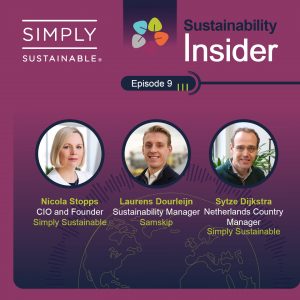
In this episode of Sustainability Insider, host Nicola Stopps, Founder of Simply Sustainable, is joined by Sytze Dijkstra, Netherlands Country Manager at Simply Sustainable and Laurens Dourleijn, Sustainability Manager at Samskip – a global logistics company at the forefront of the low-carbon transition.
Laurens speaks about the real experience of cutting emissions within a complex, multinational, multi-modal transportation business. He offers an honest look at what transition work feels like on the ground – from navigating new technologies and shifting regulations to driving change in a highly cost-sensitive industry.
The conversation also explores Laurens’ approach to bringing colleagues along on the journey, providing clarity and direction while empowering others to co-create solutions that work in practice.
At Simply Sustainable it is our people that lead the transformative changes we are enabling with our work through our clients. We are looking for passionate, bright and committed individuals that are looking to have the same impact on society that we are collectively driving for.