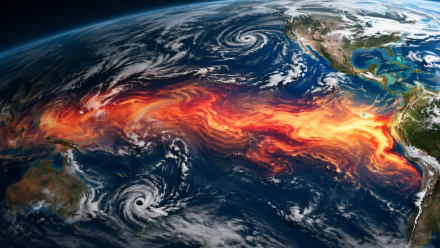
A very strong El Niño is developing: What it could mean for businesses and how to prepare
Written by: Rosie Pidgeon, Client Strategies Partner | Last updated: 17.08.2026
Businesses cannot control how the current El Niño develops. They can control how prepared they are. [1] As climate volatility becomes a more significant business risk, organisations are increasingly recognising that physical climate hazards can affect far more than the weather. They influence supply chains, commodity markets, infrastructure resilience, operational continuity and long-term business performance. [10]
One of the most closely watched climate signals today is El Niño. While headlines often focus on whether it will become a “Super El Niño”, businesses should be asking a different question: What could this very strong El Niño mean for our organisation, and are we prepared for its potential impacts? [1][2][6]
Events such as El Niño can be seen as an opportunity for organisations to better understand physical climate risks, strengthen resilience across operations and supply chains, and make more informed decisions before disruption occurs. [10]
How could a Super El Niño affect businesses?
The greatest business impacts are rarely caused by a single climate event. They emerge when multiple pressures reinforce one another. [6][10] A period of drought may reduce crop yields, increasing commodity prices and affecting manufacturers. Flooding can interrupt transport routes and delay deliveries, while prolonged heat increases energy demand, reduces workforce productivity and places additional pressure on infrastructure. Even organisations with limited direct exposure can experience disruption through suppliers, logistics partners or customers. [6][10]
Key business impacts include:
Supply chain disruption: Flooding, drought and extreme heat can affect transport infrastructure, manufacturing sites, ports and logistics networks, increasing delays, shortages and costs across global supply chains. [6][10]
Commodity and resource volatility: Lower agricultural yields and reduced water availability can increase price volatility across food, beverage and manufacturing sectors, while placing additional pressure on critical raw materials. [6][10]
Operational resilience: Heatwaves can increase cooling demand while drought affects water availability and hydropower generation, leading to higher operating costs and greater pressure on critical infrastructure. [6][10]
People and productivity: Extreme temperatures can affect employee wellbeing, absenteeism, travel and productivity, particularly for organisations with outdoor workforces or extensive logistics operations. [10]
Strengthen financial, governance and disclosure risk: Investors, insurers, regulators and customers increasingly expect organisations to understand and manage physical climate risks. Demonstrating a clear understanding of these risks supports stronger governance, more credible disclosures and greater stakeholder confidence. [11][12]
I believe climate volatility is becoming a defining business challenge, with both transition and physical climate risks becoming increasingly material. El Niño is another reminder that organisations need to understand how climate-related events could affect their financial performance, operations and long-term resilience.” Rosie PidgeonClient Strategies Partner
How can organisations prepare?
Preparing for El Niño is less about responding to a single seasonal forecast and more about understanding where physical climate risks could become financially material. [10][11][12]
Organisations that understand their operational dependencies, supplier exposure and critical assets are generally able to respond more effectively when disruption occurs. Building resilience before an event happens often reduces operational impacts, limits financial losses and supports faster recovery. [10]
Rather than treating climate resilience as a standalone sustainability initiative, organisations should integrate it into enterprise-wide decision making. This includes: [11][12]
Identifying facilities, suppliers, commodities and markets with the greatest exposure to heat, flooding, drought or water stress. [10]
Stress testing critical operations against potential disruption, including supplier failure, transport delays and commodity price volatility. [10][11]
Engaging key suppliers to understand their climate exposure, resilience measures and business continuity arrangements. [10]
Reviewing procurement strategies to reduce dependence on single suppliers or climate-sensitive regions where appropriate. [10]
Embedding physical climate risk into governance so procurement, finance, operations and risk teams can make decisions using a shared understanding of climate exposure. [11][12]
Taken together, these actions help organisations anticipate disruption, adapt more quickly and strengthen resilience over the long term. [10]
Looking beyond the current El Niño
El Niño is now firmly established and expected to intensify into a very strong event. Although “Super El Niño” is not a formal scientific classification, current forecasts indicate an unusually powerful event, with climate impacts expected to continue into 2027. [1][2]
What is becoming increasingly certain is that climate volatility will continue to shape the operating environment for businesses across every sector. Organisations that use El Niño as a catalyst to strengthen climate adaptation, supplier resilience and governance will be better placed to respond not only to this event, but also to the broader pattern of physical climate risks that is emerging. [9][10]
At Simply Sustainable, we help organisations understand where physical climate risks could become commercially significant through climate risk and scenario analysis and supplier due diligence. Turning climate data into practical business insight helps organisations strengthen resilience, make better-informed decisions and prepare for an increasingly uncertain future.
El Niño FAQs
What is El Niño and what is a Super El Niño?
El Niño is the warm phase of the El Niño–Southern Oscillation, a naturally occurring climate pattern across the tropical Pacific Ocean. During an El Niño event, sea surface temperatures become warmer than average, influencing rainfall, temperatures and storm activity around the world. [3][4][7]
The term “Super El Niño” is widely used by the media but is not a formal scientific classification used consistently by meteorological agencies. It generally describes exceptionally strong El Niño events with unusually high sea surface temperature anomalies and widespread global impacts. The events of 1982–83, 1997–98 and 2015–16 are commonly recognised as examples. [5][6]
These events were associated with severe droughts, flooding, wildfires, coral bleaching and widespread disruption to agriculture, infrastructure and ecosystems. While every El Niño develops differently, history demonstrates that stronger events can have significant economic and operational consequences. [5][6]
How strong is the current El Niño expected to become?
The World Meteorological Organization confirmed on 3 July 2026 that El Niño conditions had developed in the tropical Pacific and were forecast to strengthen rapidly over the following months. WMO’s seasonal update indicated rapid development into a strong event during July–September 2026, although the exact peak intensity remains uncertain. [1]
Although the phrase “Super El Niño” frequently appears in media coverage, the more decision-useful focus for organisations is the implication of a strong El Niño occurring against a backdrop of rising global temperatures. [1][6][9]
The last widely recognised Super El Niño occurred in 2015–16. More recently, the 2023–24 El Niño was among the strongest events on record and contributed to record global temperatures, although the informal “Super El Niño” label is not applied consistently across scientific organisations. [2][8][9]
Why could this El Niño have greater impacts?
El Niño itself is a natural climate phenomenon. What has changed is the climate in which it now occurs. [3][9]
Global temperatures have increased significantly over recent decades. As a result, El Niño now adds to an already warmer climate system, increasing the likelihood of more intense heat, greater evaporation, water stress and extreme weather in many regions. [1][2][9][10]
For businesses, the challenge is not predicting exactly how strong El Niño will become. It is understanding how a changing climate is increasing the frequency and severity of operational disruption. Climate adaptation is therefore no longer simply an environmental issue. It has become a business resilience issue. [10][11][12]
Organisations that understand their exposure to physical climate risks are better placed to anticipate disruption, prioritise investment and maintain business continuity when extreme weather occurs. [10]
Impacts and dependencies
We help you understand how your business impacts the world around it. And what it depends on. So you can manage risks, uncover opportunities, and make smarter, more sustainable decisions.
Sustainability can be a complex landscape, we work with your organisation to fully equip your employees and stakeholders with the necessary skills and knowledge so everyone can engage in your strategies.